Zirconium & E-max Veneers Care Guide: How to Maintain Your Smile for 20+ Years
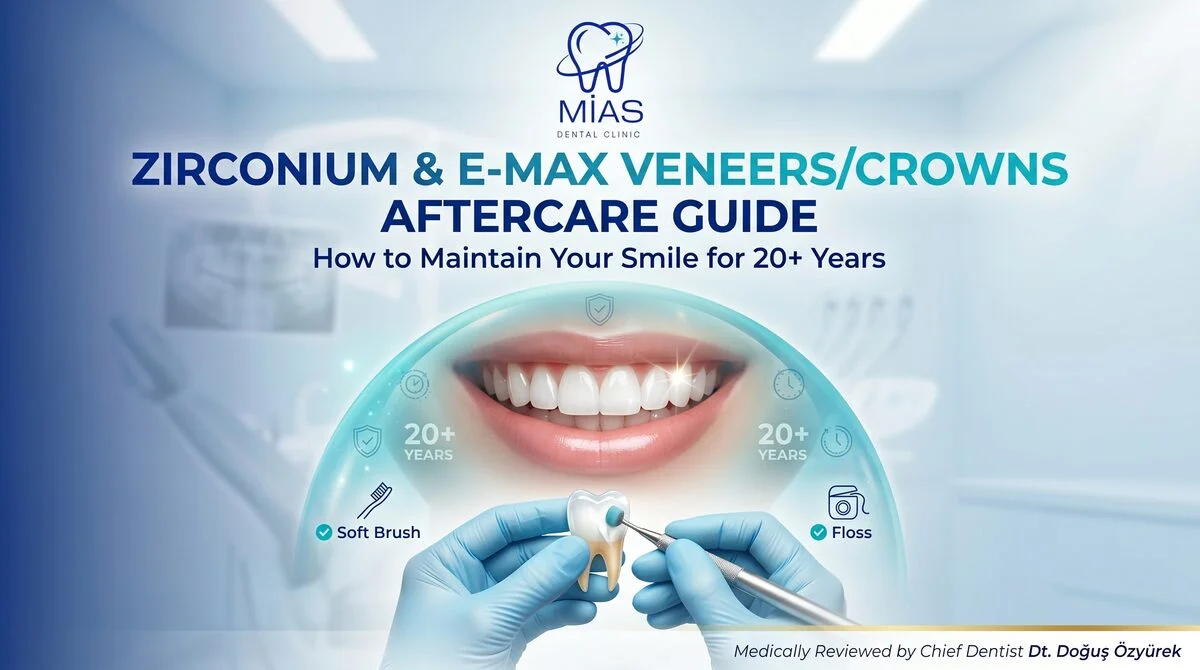
Getting a Hollywood Smile makeover in Turkey with E-max porcelain veneers or high-translucent Zirconium crowns is a major aesthetic and financial investment. Although modern dental ceramics are engineered with extreme physical resilience, they are not completely indestructible. The clinical longevity of your new restorations depends entirely on your daily aftercare routine.
Many patients believe that because prosthetic teeth cannot develop dental cavities, they do not require strict oral hygiene. This is a critical clinical misconception. While the ceramic materials themselves do not decay, the natural tooth margins underneath and the surrounding gum tissue remain highly vulnerable to plaque, bacterial infiltration, and gum recession.
This comprehensive clinical care guide, prepared and medically reviewed by Chief Dentist Dt. Doğuş Özyürek, details the essential protocols for protecting your new smile during the critical first 48 hours and maintaining it for 15 to 20+ years.
1. The Critical 48 Hours: Polymerization & Sensitivity Management
The first 48 hours following the permanent cementation of your E-max veneers or Zirconium crowns are the most critical. During this phase, the medical-grade dual-cure composite resins used to bond the restorations to your enamel undergo a final chemical polymerization process to achieve their maximum structural bond strength.
Clinical Care Rules: First 48 Hours
To ensure the resin bonding interface cures perfectly without microscopic shifts or stresses:
- Avoid Thermal Shock: Do not consume boiling hot teas, soups, or iced drinks. Sudden extreme thermal expansion and contraction can cause micro-stresses on the curing cement layer.
- Do Not Chew Hard Foods: Avoid crusty bread, steak, raw carrots, or hard candies. Stick to soft foods like pasta, yogurt, soups, and soft fish.
- Manage Pulp Sensitivity: Mild post-operative sensitivity to temperature changes and chewing pressure is normal for 7-14 days. The dental pulp (nerve) goes through a minor inflammatory phase after tooth prep and bonding chemistry. Standard over-the-counter anti-inflammatories (Ibuprofen) can resolve this.
2. Daily Oral Hygiene: Protecting the Bonding Interface
The lifetime of E-max veneers and Zirconium crowns is determined by the health of the margins where the ceramic meets the natural tooth structure. If dental plaque accumulates at this junction, bacteria will infiltrate under the restoration, resulting in marginal leakage, tooth decay, and gum recession.
Toothpaste & Brush Selection
Porcelain glaze is incredibly smooth, but it can be scratched by abrasive particles.
- Low RDA (RDA < 70) Gel Paste: Avoid whitening toothpastes containing highly abrasive silica, baking soda, or charcoal. These abrasives scratch the glossy porcelain cila (glaze) over time, leaving it matte, dull, and prone to staining. Use mild gel-based fluoridated pastes.
- Soft or Pressure-Sensitive Brush: Hard bristles can cause gum recession. A soft (soft/ultra-soft) manual brush or an electric toothbrush equipped with a pressure sensor is ideal. Angle the bristles at 45 degrees toward the gum line and brush gently.
Interdental Hygiene & Mouthwash
Cleaning between the teeth and under bridge pontics is crucial to prevent plaque biofilm accumulation.
- Daily Flossing or Interdental Brushing: Use dental floss daily. Gently slide it up and down along the sides of each tooth. For dental bridges, use superfloss to clean underneath the suspended crown (pontic).
- Alcohol-Free Mouthwash: Avoid alcohol-containing mouthwashes. The ethanol can slowly dissolve and break down the composite resin bonding agents holding your veneers and crowns, leading to marginal leakage over the years.
- Water Flosser (Waterpik): Using a water flosser on a medium pressure setting is highly recommended. It cleans out the deep periodontal pockets and under-bridge areas that manual floss cannot reach.
3. Diet & Nutrition: Mechanics of Mastication & Staining
E-max is a highly aesthetic material with a flexural strength of 400-500 MPa, while Zirconium features a strength of 1,200+ MPa. Despite their durability, they can chip if subjected to improper forces, especially shear stress.
Mastication Mechanics & Shear Force
Your teeth are designed to withstand vertical forces (chewing up and down). However, they are weak against horizontal or shear forces (pulling and twisting). Biting directly into foods with front teeth creates a lever action that generates massive shear stress at the bonding interface.
| Food Category | Risk Mechanism | Safe Management Protocol |
|---|---|---|
| Hard Fruits & Vegetables (Apples, raw carrots, pears) | Biting down and pulling exerts a powerful shear force on front veneers, which can cause debonding or chipping. | Never bite directly. Slice them into small, bite-sized pieces with a knife and chew them using your back molars. |
| Sticky & Chewy Foods (Caramel, Turkish delight, toffee, chewing gum) | Creates high suction tension that can fatigue the cement interface or dislodge older restorations. | Avoid sticky items or chew them gently on the back teeth. Brush immediately after consumption. |
| Shells, Bones & Seeds (Popcorn kernels, olive seeds, hard nuts, bones) | Accidentally biting down on these creates an extreme point load, causing localized porcelain fracture (chipping). | Be cautious with salads containing unpitted olives, meat with bones, and unpopped popcorn kernels. |
Staining & Color Management
High-grade E-max porcelain and Zirconium blocks are completely non-porous. This means they are highly resistant to staining and will not change color over time, unlike natural teeth. However, the composite bonding resin cement at the margins and your natural teeth are porous and can discolor from coffee, red wine, tea, and tobacco pigments. This can look like dark or yellow borders around your restorations.
Clinical Tip: If you consume dark beverages (coffee, red wine, cola, dark tea), rinse your mouth with water immediately afterward to prevent pigment accumulation on the bonding cement lines. Avoid heavy smoking to maintain healthy, pink gums.
4. Bruxism (Teeth Grinding) & Protective Nightguards
Bruxism (involuntary grinding or clenching of teeth during sleep) is the leading cause of early dental restoration failure. Patients who grind their teeth can exert forces exceeding 800 to 1,000 Newtons (about 80-100 kg of pressure) during deep sleep. This is up to three times the pressure generated during normal chewing.
When porcelain crowns or veneers grind against each other under this level of force, the material undergoes structural fatigue. This leads to hairline fractures, major chipping, or complete debonding.
The Solution: Custom Hard-Soft Occlusal Splint
If you show signs of grinding (wear facets, jaw muscle soreness, morning headaches), Dt. Doğuş Özyürek will design a custom protective nightguard.
- Shock Absorption: The soft inner layer cushions your restorations, absorbing grinding pressure and protecting the bond interface.
- Friction Prevention: The hard outer layer allows your teeth to glide smoothly over the surface, preventing porcelain-on-porcelain wear.
- Mandatory Protection: Wearing your nightguard every night is mandatory if you have E-max veneers and suffer from bruxism.
5. Professional Dental Maintenance: Every 6 Months
While daily home care is vital, professional clinical checkups every six months are essential for long-term success. During these routine diagnostic checkups at MIAS Dental Clinic, we perform key preventative procedures:
Marginal Seal and Leakage Inspection
We check the margins of your veneers and crowns using special dental explorers and digital X-rays to ensure the cement seal is intact and no microscopic gaps have formed.
Gentle Ultrasonic Scaling & Polish
Any accumulated tartar (calculus) is removed using specialized non-abrasive ultrasonic scalers. We then polish the restoration boundaries with fine polishing paste to restore the original gloss of the glaze layer.
Bite Alignment Adjustment
As your natural jaw joints and opposing teeth shift slightly with age, your occlusion (bite) can change. We verify that there are no high spots causing excessive focal pressure on any single restoration, making minor adjustments if necessary.
Frequently Asked Questions (FAQ)
Can natural teeth decay underneath a dental crown?
Yes. Although the crown material itself is immune to decay, the natural tooth core underneath can rot if plaque biofilm accumulates along the margin line. If the cement seal washes out, food particles and bacteria can seep under the crown, causing decay that is often painless until it reaches the root canal. Consistent flossing and regular cleanings are essential to prevent this.
Do E-max or Zirconium restorations discolor or stain?
No. Authentic E-max and Zirconium are highly glazed, non-porous ceramics that do not stain from coffee, red wine, or tobacco. However, the composite bonding resin cement at the margins can discolor, and your surrounding natural teeth can stain. Rinsing your mouth with water after drinking coffee or tea will help maintain a uniform color.
What should I do if a crown or veneer feels loose or makes a clicking sound?
If you feel movement or hear a "click" when chewing, it indicates that the resin cement has washed out. Contact your dentist immediately. Do not attempt to pull it off yourself or chew on that side. The dentist can remove the restoration, clean the underlying tooth, and recement it securely.
How long do E-max veneers and Zirconium crowns last?
With correct aftercare, high-quality E-max veneers and Zirconium crowns can last between 15 and 20+ years. Longevity is directly tied to oral hygiene, avoiding excessive shear forces, and wearing a custom nightguard if you grind your teeth.
Is hot/cold sensitivity normal after getting veneers?
Yes, mild sensitivity is normal for the first 1 to 2 weeks. The tooth preparation process and the application of bonding adhesives can temporarily irritate the pulp. Over-the-counter pain relief and desensitizing toothpastes will help resolve this. If sensitivity persists beyond 4 weeks, contact your dentist.
Protect Your Smile with Expert Aftercare Support
Follow our clinical recommendations to ensure your smile makeover lasts a lifetime. For checkups, custom nightguards, or any questions about your restoration care, contact our guest coordinators.